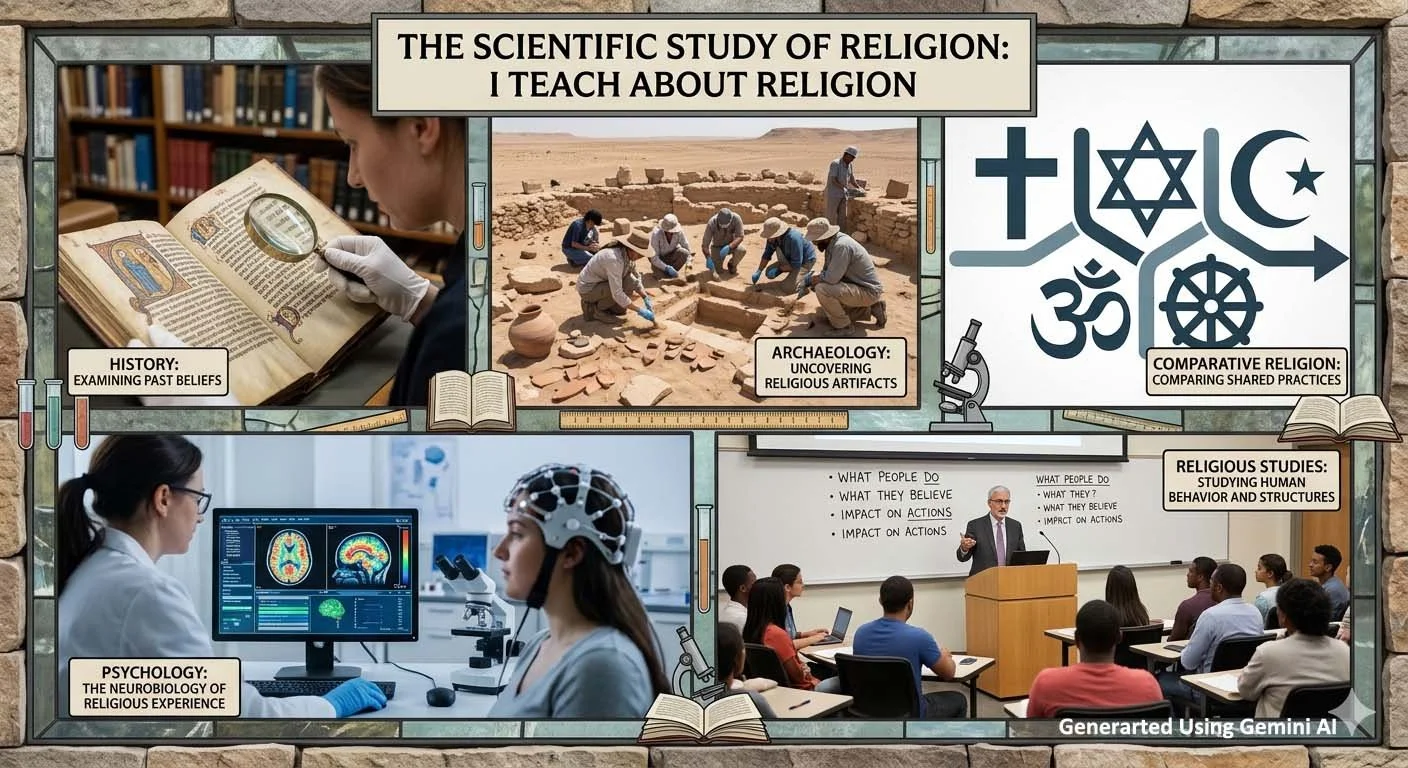
Introduction to Religious Studies from a Scientific Perspective
Religion is often a subject of faith. But given that it is a thing that “people do”, the scientific method can be brought to bear as an approach to studying it, which has created several distinct fields of academic study. The general mantra for teachers in those academic disciplines is: “I do not teach religion, I teach about religion”. Ideally the goal is not to determine the truth or falsehood of a religious belief, but rather to study what people do, what they say, what they believe, and how it impacts their actions, social structures, and psychological well-being. Attempts to study religion from a scientific perspective have involved the fields of history, archaeology, comparative religion, psychology, and religious studies. We will briefly describe the history of this endeavor, and the philosophical difficulties and approaches involved.
James Carroll received a PhD in Computer Science with an emphasis on Artificial Intelligence and a minor in Ancient Near Eastern History in 2010 from Brigham Young University. His dissertation was on the Statistics of Machine Learning, and the Computer Assisted annotation of ancient religious texts. As a graduate student he taught classes on Artificial Intelligence, Isaiah, The Book of Mormon, and The Pearl of Great Price in the Ancient Scripture Department. After graduation he worked at Los Alamos National Laboratory, first as a post doc, and then as a scientist, where he worked primarily on radiography. He is currently researching the application of Machine Learning and Artificial Intelligence for the analysis of Radiographic Image data. He currently attends the Unitarian Universalist Church of Los Alamos, where he teaches Adult Religious Education classes on comparative religion and the Old Testament. His classes are available online at: https://www.youtube.com/@jlc46