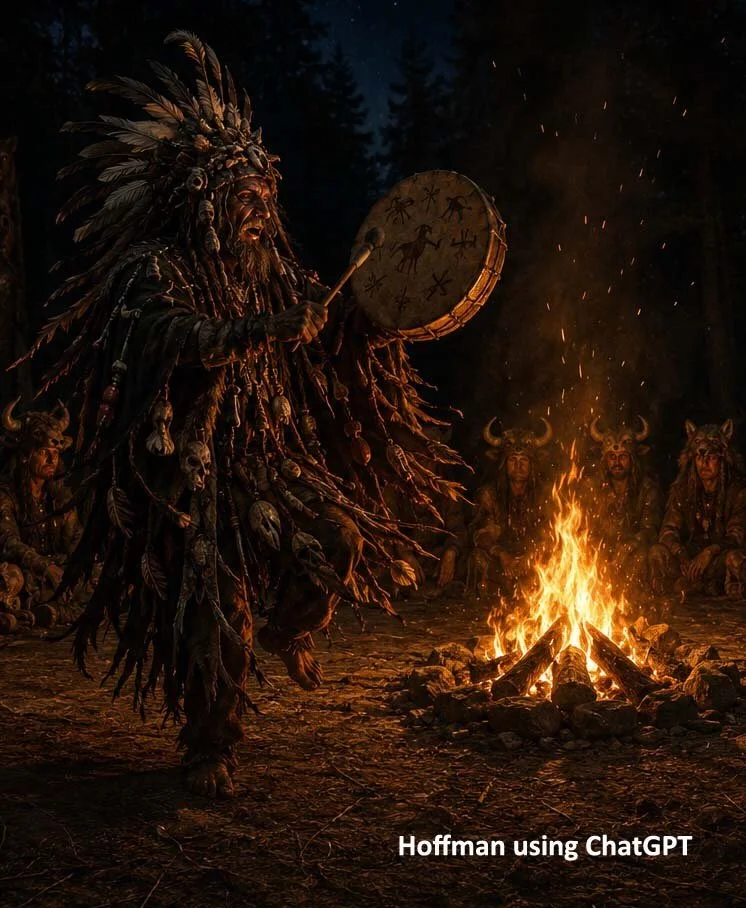
Saved by the Spirits: Did religion rescue paleolithic humans from extinction?
All hominin species, except for one, have gone extinct. Even a successful species like Homo erectus, who persisted on Planet Earth for more than one and a half million years, is no longer around. Genomic analysis shows that the population of Homo sapiens declined to a very small number during the last ice age, indicating that we too may have been on the way out, along with Homo neanderthalensis and the others. Around 50,000 to 70,000 years ago, something happened to arrest our extinction and turned us into one of the most dominant species on the planet today.
What made the difference? Researchers have proposed genetic mutations, advanced tools, an improved climate, or cultural innovation as the key factor. In this talk we will look at these possibilities and examine the evidence that behavioral change is a better alternative. Since behavior does not fossilize, the arguments are indirect. Researchers often rely on the debatable proposition that present-day small-scale indigenous communities around the world furnish useful models of paleolithic behavior. All such communities have distinctive cultural practices that can be called “religious”, including shamanism, initiations, and ritual alliances - “secret societies”. The pervasiveness of the practices is taken as evidence of their antiquity. We will focus on the ways that early religious practices probably promoted social unity and could have fostered the transition from static to cumulative culture, leading to improved survival rates. Our discussion will raise the possibility that it was non-material influences of a religious nature - “the spirits” - that rescued humanity from extinction.
Dr. Nelson M. Hoffman is retired after a career as a physicist at Los Alamos National Laboratory, working most recently in the Plasma Theory and Applications Group of the Computational Physics (XCP) Division. He earned a B.A. in Physics from Rice University in 1970, and a Ph.D. in astronomy from the University of Wisconsin in 1974. His research interests were mainly in the areas of laser fusion and plasma physics, and statistical inference (“machine learning”) applied to data analysis. He has authored or co-authored more than 90 technical publications, which have garnered more than 3200 citations. He is a member of First United Methodist Church of Los Alamos, and is active in the Kairos Prison Ministry. He is a founding member and past president of the Los Alamos Faith & Science Forum (LAF&SF). Influenced by the writings on the history of science and culture by Toby Huff, Lawrence Principe, James Hannam, David Lindberg, Jonathan Sacks, Joseph Henrich, and many others, he believes it is highly likely that, without the crucial influence of Christianity in human cultural history, modern science would not even exist.
